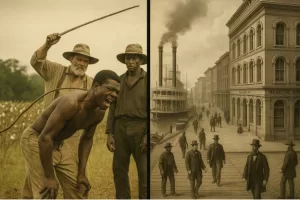
How often have you heard about White Privilege? Let me remind you of its basic tenets:
- Whites benefited greatly from the exclusion of black people.
- America’s earliest wealth was built on the backs of enslaved Africans. The plantations of the South flourished because black labor fueled the economy.
- White landowners gained vast fortunes, and even those without property inherited a privileged place above their black fellow citizens.
- Entire industries—cotton, sugar, tobacco—rose to global dominance because of forced black labor.
- Cities and ports grew rich off the trade of human beings.
- Generations of whites advanced in education, business, and politics, while black Americans were barred from the very rights that made such advancement possible.
- Jim Crow cemented these gains, ensuring that the best schools, jobs, and neighborhoods remained white.
- The United States is only where it is because of its exploitation of slave labor.
In summary, the claim is that white privilege enhanced white lives and hurt black people.
This is the common story. It sounds compelling. But is it completely true?
No, it is only half the truth.
The Reality
White privilege didn’t help anyone. Yes, it hurt black people much more than whites, but it hurt whites too. In fact, as I’ll show, it actually hurt everyone. Its supposed “gains” were poisoned. The system that promised privilege also planted deep, deep rot. For everything the elite whites temporarily gained, the other whites, immigrants, and the rest of the population lost. The nation as a whole lost.
Did the elite whites really gain, or did they merely trade lasting prosperity for a fleeting illusion of superiority?
The reality is that not only could they have been more prosperous in the short term, but they could have remained wealthy had they abandoned slavery. But instead, by sticking to an evil hierarchy, almost every single slave-owning family was bankrupted (and justly so) after the war and Reconstruction.
Southern Decline vs. Northern Growth
So, as it turns out, the slave states traded real progress for a cheap substitute. The South’s entire economic model revolved around slave labor, leaving it brittle, slow to grow, and economically repressive. By 1860, nearly 90% of the nation’s manufacturing capacity was in the North, which had completely banned slavery. While the North was surging forward with railroads, factories, and universities, the South was clinging to a plantation economy that enriched a handful of elites while keeping most whites poor and uneducated.
Did the South Even Flourish?
Sure, the North did well, but didn’t the South flourish at all, even a bit, under slavery?
The answer is: No, not at all.
The South stagnated. For all the talk of Southern wealth, the vast majority of whites in the South owned no slaves and had no real path to economic advancement. They were cannon fodder in a system designed to protect the planter aristocracy. The South’s dependence on cotton and slavery wasn’t a sign of strength—it was a straitjacket. A limitation on the free market. The Civil War exposed the lie: one generation of conflict obliterated the fortunes of the planter class, left the region in ruins, and set Southern development back decades.
They had built castles on sand. Their wealth existed only as long as human beings could be bought and sold. A system built on oppression can never last in the hands of one group of oppressors. Why? Because either freedom will grow, or a new oppressor will overthrow the old one. That’s why communism fell and why dictatorships and monarchies roll over to the next ruler. The moment the system crumbled, so did their power. Even the grandest Southern estates were worth nothing when their “property” walked free.
This is the great irony: the very thing that seemed to give them unshakable dominance—free compelled labor—was the thing that destroyed them by making them weak.
Free Labor vs. Forced Labor
As I’ve noted in my previous books, ten slaves (75% of slaveholders owned fewer than 10 slaves) unwillingly forced to work on a plantation, surrounded by the manpower to keep them enslaved—not only by the owner, but also by an entire wasteful, costly infrastructure of control: local sheriffs, slave catchers, patrols, bounty hunters, overseers, informants, and court systems—all designed to suppress escape, punish resistance, and maintain the illusion of order—could not compete with four free independent contractors, paid a fair wage and competing to provide the best service as fast as possible so they could move on to the next job and make more money.
That’s why the North was so wealthy, prosperous, and powerful. It had minimal government overhead. By contrast, the South poured enormous resources into maintaining an oppressive hierarchy, all funded or supported to protect a system that rewarded only a narrow elite. What you had was effectively a wasteful socialist state designed specifically for the benefit of only the elites.
Poor Whites Were Exploited Too
What about the poor Southern whites? Didn’t they gain privilege on the backs of the slaves, as is claimed?
No. As we noted, the poor whites were kept landless and voiceless, pacified by a false sense of being “better than” the people they oppressed. They didn’t rise; they were pacified. The promise of whiteness kept them docile. Instead of uniting with enslaved or freed black Americans to demand free market wages and the freedom to buy land, they were convinced their skin color was their ticket to dignity. It wasn’t. They were used. In truth, poor whites suffered alongside black Americans in a system designed to keep both groups powerless while the elites ruled.
The National Loss
And what of the nation itself? How much progress, how many inventions, how much cultural brilliance was stolen from America by chaining millions of black minds and hands?
Immeasurable. Every enslaved person was a silenced voice. Every black child barred from school was a doctor who never healed, an inventor who never built, a leader who never rose. We will never know how many innovations, books, businesses, or works of art were lost because America chose chains over opportunity.
Consider that even with the crushing weight of slavery and Jim Crow, black Americans still produced inventors like Garrett Morgan (traffic signals, gas masks), innovators like George Washington Carver (agricultural science, peanut butter), and cultural giants who reshaped music, literature, and art.
Now imagine what could have been if their full potential had been unleashed.
This is the unspoken cost of America’s racial hierarchy—of what we call white privilege: our progress as a nation was throttled.
A Cheap Substitute for Prosperity
So, you see, slavery and exclusion didn’t elevate whites to greatness; they shackled everyone to mediocrity. They delayed our nation’s economic development, fractured our social fabric, and left us morally compromised.
The so-called “privilege” of whiteness was, in the end, a cheap and corrosive substitute for shared prosperity.
What Could Have Been
What if, from the beginning, black Americans had been free to own, build, innovate, and lead alongside their white neighbors? What would this country look like today? How many breakthroughs would we have seen? How much wealth would have been created? How many lives would have been saved from the violence and hatred that followed?
“White privilege” came at a devastating price, but not just for black Americans. It cost all of us—whites, blacks, Native Americans, Hispanics, immigrants—everyone.
Let’s be real: white privilege was a lie. It didn’t privilege most whites, and it destroyed everything that those who did temporarily gain from it ever had.
The Pattern Repeats
We see this not only in slavery but in all systems of government and laws that are oppressive.
For instance, the simple truth is that the North Korean dictator Kim Jong-un would be twenty times as rich if North Korea had a free market like South Korea. In fact, there are over 12 South Korean businessmen who are each worth more—and even double—what Kim Jong-un is worth. Imagine if Jong-un had let the people under him freely grow their own companies. Imagine what his net worth would be. Ironically, this could happen as quickly as a few years if he did so.
And it is the same for Cuba, Venezuela, Gaza, the West Bank—everywhere we see oppression regimes with market constraints. That’s what we saw in the American South.
And to be fair, this is really true even today in the U.S., in areas where crony capitalists have coerced the government into allowing them to suppress their competitors. Remember when the shackles were taken off the telephone market we got cheap phones, free international call, cell and satellite phones.
Final Conclusion
In short, there was never such a thing as white privilege—only evil wicked black oppression and national decline.
In the end, the morally constrained free market is the only thing that works to bring wealth and prosperity to all.
\
That’s how God designed it.