
Dallas, TX USA
Info(at)Everyblm.com
Written by Contributing Author, Charles Wekesa
In the aftermath of such tragedies, there is often an understandable search for explanation. Commentators may look to psychological struggles, societal pressures, or cultural influences. While those factors may provide context, they cannot erase the reality of deliberate evil. This was not simply the result of mental instability—it was an act carried out with precision, intent, and ideological motivation. The shooter’s hateful writings, filled with anti-Catholic, antisemitic, and racist rhetoric, expose the darkness that fueled the crime
A Call to Protect Life and Faith
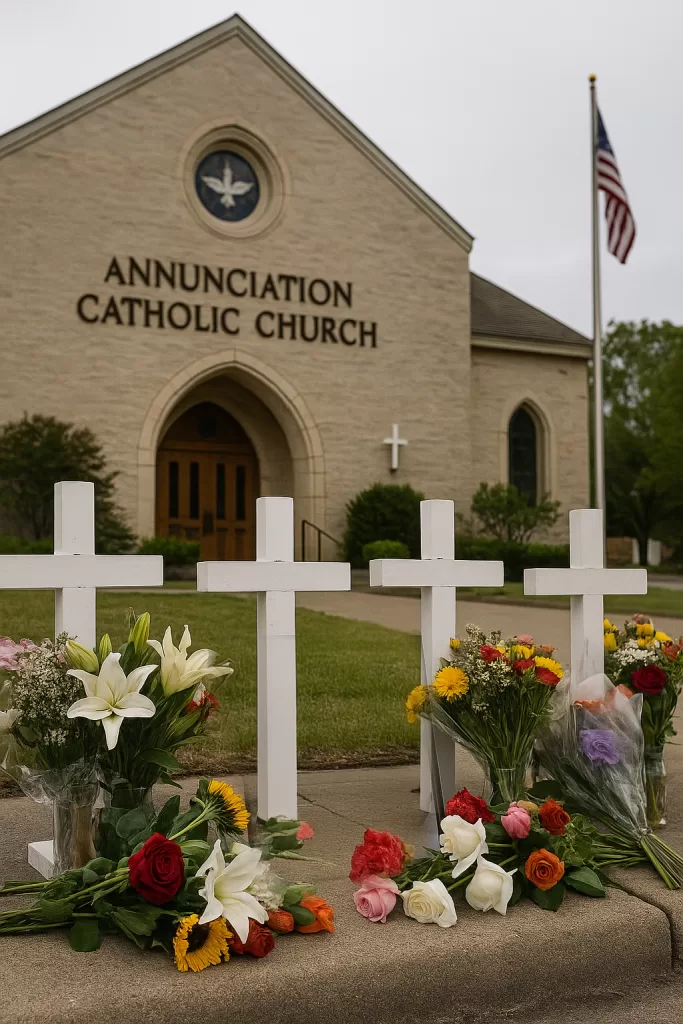
On August 27, 2025, a horrific tragedy struck Minneapolis when the sacred peace of a Catholic parish was shattered by a mass shooting inside Annunciation Catholic Church and School. The attacker, identified as 23-year-old Robin M. Westman, carried out a carefully orchestrated and deliberate act of violence during a back-to-school Mass, a time that should have represented joy, community, and renewal for children and their families. Armed with multiple legally purchased firearms, including a rifle, shotgun, and pistol, Westman opened fire through the stained-glass windows of the church while barricading exits to maximize suffering. This calculated assault left two innocent children dead and at least eighteen others injured, many of them young students. The attack has rightly been condemned across the nation as not only a tragedy but also as a direct assault on the values of faith, family, and the sanctity of human life.
The Heinous Nature of the Attack
This was not a random act of sudden rage or a spontaneous loss of control. The Annunciation Catholic Church shooting was premeditated, intentional, and designed to cause maximum devastation. The act of firing into a church filled with children and families during worship represents one of the gravest violations imaginable. Churches have historically been seen as sanctuaries, places where the faithful gather in safety to seek peace, guidance, and renewal. To invade that sacred trust with bullets is to desecrate not only a building but also the very concept of refuge. The barricading of exits demonstrates forethought and cruelty, stripping away the victims’ opportunity to escape. Such an attack cannot be minimized or explained away by personal struggle alone. It stands as a deliberate act of evil, one that reveals how destructive unchecked hate and brokenness can become when directed toward the innocent.
The Innocence of the Victims
The shooting claimed the lives of two children: eight-year-old Fletcher Merkel and ten-year-old Harper Moyski. These were not anonymous statistics, but beloved children whose lives carried immeasurable promise. Fletcher and Harper represented the joy of youth, the aspirations of families, and the future of their parish community. Their sudden and violent deaths ripped a hole in the lives of their parents, siblings, and classmates. Every empty desk in their school classroom and every pew in their parish church now stands as a haunting reminder of their absence. The families of the victims must carry grief that words cannot adequately express, while survivors—many of them children between the ages of six and fifteen—will carry scars that will last a lifetime. The community is left to grapple with trauma that stretches far beyond physical wounds, encompassing emotional devastation, spiritual confusion, and social upheaval.
An Assault on Religious Freedom and Safety
This attack also stands as a direct violation of the principle of religious freedom. For generations, churches in America have served as sanctuaries, not only in the spiritual sense but also in a physical one. People of faith have gathered within their walls to celebrate sacraments, mourn losses, and seek solace. To have that sense of safety destroyed in such a violent manner shakes not only the local Catholic community but people of faith nationwide. When worshippers must fear for their lives in church pews, it raises profound questions about society’s ability to protect fundamental freedoms. Religious freedom is not simply the right to believe privately; it is the right to worship publicly and safely without harassment or threat. By targeting Catholics during Mass, this attack became not only an assault on individuals but also a strike against one of the most foundational liberties enshrined in the American Constitution.
Moral Clarity: Evil Must Be Named
In the aftermath of such tragedies, there is often an understandable search for explanation. Commentators may look to psychological struggles, societal pressures, or cultural influences. While those factors may provide context, they cannot erase the reality of deliberate evil. This was not simply the result of mental instability—it was an act carried out with precision, intent, and ideological motivation. The shooter’s hateful writings, filled with anti-Catholic, antisemitic, and racist rhetoric, expose the darkness that fueled the crime. Markings on the weapons included slogans glorifying violence and calling for political assassination, echoing the shooter’s fascination with past mass killers. Such details confirm that this was not random chaos but intentional hatred given form through violence. To confront this reality requires moral clarity: we must name this act for what it was—evil. Refusing to use that language only minimizes the gravity of what occurred and weakens society’s resolve to prevent it from happening again.
EBLM’s Pro-Life Commitment: Every Life is Sacred
We at Every Black Life Matters (EBLM) condemn this atrocity with the strongest possible language. As a pro-life organization, we affirm that every human life, from conception to natural death, carries inherent value and dignity. This tragic loss of young lives in a church strikes at the very heart of the pro-life ethic. Pro-life advocacy is not limited to protecting the unborn, though that remains central. It also includes safeguarding children in classrooms, parishioners in churches, families in neighborhoods, and elders in care homes. The shooter’s actions represent the precise opposite of these values: a worldview that disregards the sanctity of life, replacing it with nihilism, hatred, and destruction. By standing firmly against such violence, we underscore our conviction that human life is sacred and must be defended wherever it is threatened.
EBLM’s Stand Against Violence in Communities
For years, we have worked to protect vulnerable communities by promoting family stability, mentorship, and educational opportunity. Our organization believes that violence can be prevented when communities invest in strengthening families, fostering moral responsibility, and cultivating environments where children are nurtured rather than neglected. The Annunciation Catholic Church shooting underscores the importance of this mission. When young people are exposed to ideologies that devalue life and glorify violence, the consequences can be catastrophic. Our pro-life stance extends beyond opposition to abortion—it is a comprehensive commitment to life-affirming communities. That means opposing gang violence in inner cities, resisting policies that weaken families, and condemning acts of terror like the one carried out in Minneapolis. This is not an isolated issue but part of a broader cultural crisis that demands moral courage and consistent pro-life witness.
The Role of Hate and Ideology
The investigation into the Annunciation Catholic Church shooting reveals the disturbing influence of ideology. The FBI has confirmed that the case is being treated as both a potential hate crime and an act of domestic terrorism. Westman’s manifesto contained not only anti-Catholic sentiments but also antisemitic and racist language. When combined with the glorification of mass shooters and violent slogans inscribed on weapons, this ideology becomes lethal. It is essential to recognize how dangerous rhetoric, when left unchecked, can metastasize into acts of violence. Societies that tolerate hate-filled speech, normalize bigotry, or trivialize violent fantasies provide fertile ground for extremists. The consequences are not limited to one group or community; they ripple outward, threatening all people. Combating such ideology requires vigilance, education, and moral leadership across institutions, from families to schools to faith organizations.
A Call to National Reflection and Policy Renewal
The tragedy in Minneapolis compels the nation to pause and reflect on deeper issues. How has violence become so normalized that children are targeted in churches and schools? How has ideology become so poisoned that worshippers are considered enemies? These questions cannot be answered solely with simple policy proposals. While legislative action on issues like gun access and church security may be debated, the broader crisis is cultural and moral. Families, educators, and faith leaders must take responsibility for shaping the values of future generations. Communities must cultivate resilience, virtue, and reverence for life. Political leaders must move beyond partisanship to protect citizens where they are most vulnerable. The safety of children in schools and churches should transcend ideology—it must become a non-negotiable moral imperative shared by all Americans.
Closing with Hope and a Pro-Life Vision
Though the grief is deep and the wounds fresh, hope must remain. Across Minneapolis, vigils have been held, prayers have been lifted, and neighbors have come together in solidarity. Communities are rising together, demonstrating that even in tragedy, love is stronger than hate. Every Black Life Matters calls upon Americans to join in building a pro-life vision that goes beyond words and into action. That vision affirms life at every stage, condemns violence in every form, and protects families in every community. The memory of Fletcher Merkel and Harper Moyski must not fade into statistics; their names should echo as a call to ensure that no other children meet the same fate in their schools or churches. Evil may seek to silence the faithful and to destroy the innocent, but it cannot overcome the light of life, faith, and love. By standing together with moral clarity, compassion, and pro-life conviction, the nation can honor the victims and build a safer, life-affirming future for generations to come
A Call to Protect Life and Faith
On August 27, 2025, a horrific tragedy struck Minneapolis when the sacred peace of a Catholic parish was shattered by a mass shooting inside Annunciation Catholic Church and School. The attacker, identified as 23-year-old Robin M. Westman, carried out a carefully orchestrated and deliberate act of violence during a back-to-school Mass, a time that should have represented joy, community, and renewal for children and their families. Armed with multiple legally purchased firearms, including a rifle, shotgun, and pistol, Westman opened fire through the stained-glass windows of the church while barricading exits to maximize suffering. This calculated assault left two innocent children dead and at least eighteen others injured, many of them young students. The attack has rightly been condemned across the nation as not only a tragedy but also as a direct assault on the values of faith, family, and the sanctity of human life.
The Heinous Nature of the Attack
This was not a random act of sudden rage or a spontaneous loss of control. The Annunciation Catholic Church shooting was premeditated, intentional, and designed to cause maximum devastation. The act of firing into a church filled with children and families during worship represents one of the gravest violations imaginable. Churches have historically been seen as sanctuaries, places where the faithful gather in safety to seek peace, guidance, and renewal. To invade that sacred trust with bullets is to desecrate not only a building but also the very concept of refuge. The barricading of exits demonstrates forethought and cruelty, stripping away the victims’ opportunity to escape. Such an attack cannot be minimized or explained away by personal struggle alone. It stands as a deliberate act of evil, one that reveals how destructive unchecked hate and brokenness can become when directed toward the innocent.
The Innocence of the Victims
The shooting claimed the lives of two children: eight-year-old Fletcher Merkel and ten-year-old Harper Moyski. These were not anonymous statistics, but beloved children whose lives carried immeasurable promise. Fletcher and Harper represented the joy of youth, the aspirations of families, and the future of their parish community. Their sudden and violent deaths ripped a hole in the lives of their parents, siblings, and classmates. Every empty desk in their school classroom and every pew in their parish church now stands as a haunting reminder of their absence. The families of the victims must carry grief that words cannot adequately express, while survivors—many of them children between the ages of six and fifteen—will carry scars that will last a lifetime. The community is left to grapple with trauma that stretches far beyond physical wounds, encompassing emotional devastation, spiritual confusion, and social upheaval.
An Assault on Religious Freedom and Safety
This attack also stands as a direct violation of the principle of religious freedom. For generations, churches in America have served as sanctuaries, not only in the spiritual sense but also in a physical one. People of faith have gathered within their walls to celebrate sacraments, mourn losses, and seek solace. To have that sense of safety destroyed in such a violent manner shakes not only the local Catholic community but people of faith nationwide. When worshippers must fear for their lives in church pews, it raises profound questions about society’s ability to protect fundamental freedoms. Religious freedom is not simply the right to believe privately; it is the right to worship publicly and safely without harassment or threat. By targeting Catholics during Mass, this attack became not only an assault on individuals but also a strike against one of the most foundational liberties enshrined in the American Constitution.
Moral Clarity: Evil Must Be Named
In the aftermath of such tragedies, there is often an understandable search for explanation. Commentators may look to psychological struggles, societal pressures, or cultural influences. While those factors may provide context, they cannot erase the reality of deliberate evil. This was not simply the result of mental instability—it was an act carried out with precision, intent, and ideological motivation. The shooter’s hateful writings, filled with anti-Catholic, antisemitic, and racist rhetoric, expose the darkness that fueled the crime. Markings on the weapons included slogans glorifying violence and calling for political assassination, echoing the shooter’s fascination with past mass killers. Such details confirm that this was not random chaos but intentional hatred given form through violence. To confront this reality requires moral clarity: we must name this act for what it was—evil. Refusing to use that language only minimizes the gravity of what occurred and weakens society’s resolve to prevent it from happening again.
EBLM’s Pro-Life Commitment: Every Life is Sacred
We at Every Black Life Matters (EBLM) condemn this atrocity with the strongest possible language. As a pro-life organization, we affirm that every human life, from conception to natural death, carries inherent value and dignity. This tragic loss of young lives in a church strikes at the very heart of the pro-life ethic. Pro-life advocacy is not limited to protecting the unborn, though that remains central. It also includes safeguarding children in classrooms, parishioners in churches, families in neighborhoods, and elders in care homes. The shooter’s actions represent the precise opposite of these values: a worldview that disregards the sanctity of life, replacing it with nihilism, hatred, and destruction. By standing firmly against such violence, we underscore our conviction that human life is sacred and must be defended wherever it is threatened.
EBLM’s Stand Against Violence in Communities
For years, we have worked to protect vulnerable communities by promoting family stability, mentorship, and educational opportunity. Our organization believes that violence can be prevented when communities invest in strengthening families, fostering moral responsibility, and cultivating environments where children are nurtured rather than neglected. The Annunciation Catholic Church shooting underscores the importance of this mission. When young people are exposed to ideologies that devalue life and glorify violence, the consequences can be catastrophic. Our pro-life stance extends beyond opposition to abortion—it is a comprehensive commitment to life-affirming communities. That means opposing gang violence in inner cities, resisting policies that weaken families, and condemning acts of terror like the one carried out in Minneapolis. This is not an isolated issue but part of a broader cultural crisis that demands moral courage and consistent pro-life witness.
The Role of Hate and Ideology
The investigation into the Annunciation Catholic Church shooting reveals the disturbing influence of ideology. The FBI has confirmed that the case is being treated as both a potential hate crime and an act of domestic terrorism. Westman’s manifesto contained not only anti-Catholic sentiments but also antisemitic and racist language. When combined with the glorification of mass shooters and violent slogans inscribed on weapons, this ideology becomes lethal. It is essential to recognize how dangerous rhetoric, when left unchecked, can metastasize into acts of violence. Societies that tolerate hate-filled speech, normalize bigotry, or trivialize violent fantasies provide fertile ground for extremists. The consequences are not limited to one group or community; they ripple outward, threatening all people. Combating such ideology requires vigilance, education, and moral leadership across institutions, from families to schools to faith organizations.
A Call to National Reflection and Policy Renewal
The tragedy in Minneapolis compels the nation to pause and reflect on deeper issues. How has violence become so normalized that children are targeted in churches and schools? How has ideology become so poisoned that worshippers are considered enemies? These questions cannot be answered solely with simple policy proposals. While legislative action on issues like gun access and church security may be debated, the broader crisis is cultural and moral. Families, educators, and faith leaders must take responsibility for shaping the values of future generations. Communities must cultivate resilience, virtue, and reverence for life. Political leaders must move beyond partisanship to protect citizens where they are most vulnerable. The safety of children in schools and churches should transcend ideology—it must become a non-negotiable moral imperative shared by all Americans.
Closing with Hope and a Pro-Life Vision
Though the grief is deep and the wounds fresh, hope must remain. Across Minneapolis, vigils have been held, prayers have been lifted, and neighbors have come together in solidarity. Communities are rising together, demonstrating that even in tragedy, love is stronger than hate. Every Black Life Matters calls upon Americans to join in building a pro-life vision that goes beyond words and into action. That vision affirms life at every stage, condemns violence in every form, and protects families in every community. The memory of Fletcher Merkel and Harper Moyski must not fade into statistics; their names should echo as a call to ensure that no other children meet the same fate in their schools or churches. Evil may seek to silence the faithful and to destroy the innocent, but it cannot overcome the light of life, faith, and love. By standing together with moral clarity, compassion, and pro-life conviction, the nation can honor the victims and build a safer, life-affirming future for generations to come.
Source
https://tinyurl.com/2jt4jev5
